logo logo

Demineralization

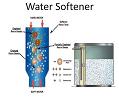
Demineralization or deionization of water is the removal of essentially all inorganic salts by ion exchange. In this process, strong acid cation resin in the hydrogen form converts dissolved salts into their corresponding acids, and strong base anion resin in the hydroxide form removes these acids. Demineralization produces water similar in quality to distillation at a lower cost for most fresh waters. A demineralizer system consists of one or more ion exchange resin columns, which include a strong acid cation unit and a strong base anion unit. The cation resin exchanges hydrogen for the raw water cations as shown by the following reactions. 

Cation Resin Exchanges Hydrogen for the Raw Water Cations

Cation Resin Exchanges Hydrogen for the Raw Water Cations

Advantages of Demineralizers are: 

  • Demineralizers can produce high-purity water comparable to distilled water for nearly every use.
  • Demineralized water is widely used for high-pressure boiler feed water and for many process waters.
  • They come in a wide variety of sizes. Systems range from laboratory columns that produce only a few liters per hour to systems that produce thousands of liters per minute.

Limitations of Demineralizers are: 

  • Like other ion exchange systems, de mineralizers require filtered water in order to function efficiently.
  • Resin foulants and degrading agents, such as iron and chlorine, should be avoided or removed prior to de mineralization.
  • Anion resins are very susceptible to fouling and attack from the organic materials present in many surface water supplies.
  • Some forms of silica, known as colloidal, or non-reactive, are not removed by a demineralizer.
  • Hot,alkaline boiler water dissolves the colloidal material, forming simple silicates that are similar to those that enter the boiler in a soluble form. As such, they can form deposits on tube surfaces and volatilize into the steam.
Related Posts with Thumbnails
bottom


Leave a Reply

bottom